

READABILITY CONFIDENCE SCORE
Beyond contrast.
Beyond font size.
Real-world readability.
Can the words that matter actually be read, recognised and acted on?
Readability Confidence Score (RCS) builds on accessibility standards by looking at the wider reading experience: background noise, hierarchy, asset quality, high-value words, format and context.
WHY ANOTHER ACCESSIBILITY LAYER?
Compliance is essential.
It is not always enough.
Standards such as WCAG provide an important accessibility baseline, particularly for digital content. RCS builds on that foundation by examining the practical readability of finished communication across formats and real-world conditions.
BUILT ON, NOT INSTEAD OF
From technical requirement to real-world use.
1 Baseline standards
Use established accessibility requirements, including WCAG where relevant, as the necessary starting point.
2 Practical readability
Assess whether size, contrast, weight, placement and format allow people to read the finished communication comfortably.
3 Brand practice
Turn the learning into repeatable decisions, templates and quality expectations before work reaches final approval.
WHAT RCS EXAMINES
The wider reading experience.
The criteria are interpreted together and in context. Material barriers remain part of the scoring and result logic rather than being treated as one more assessment category.
-
Is the text large and strong enough for the format, channel and likely viewing distance?
-
Does the text have enough separation from surrounding colour and visual elements?
-
Does the message remain readable over photography, gradients, texture, clutter or motion?
-
Can people quickly identify the main message, supporting detail and action?
-
Are the words that carry the brand, offer, benefit or action visible enough to be noticed?
-
Is there too much information to take in at once, especially in fast-scroll environments?
-
Does readability survive compression, resizing, cropping, low-resolution export or platform previews?
-
Will the communication still work on mobile, social feeds, posters, slides or other real situations?
A SCORE SHOULD NOT HIDE A FAILURE
“Yes, but everything else is ok, we can publish it…”
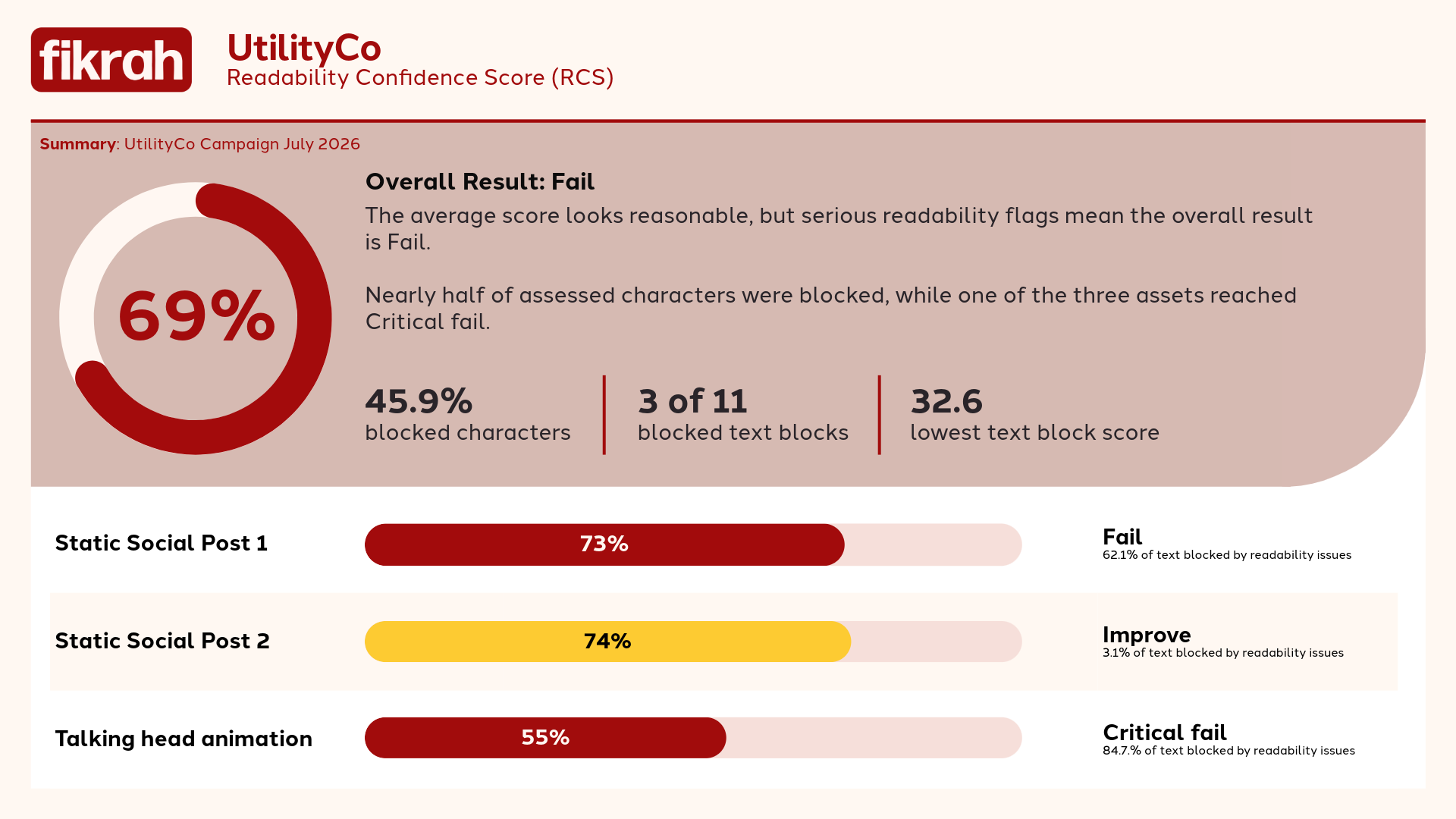
A reasonable average cannot cancel a serious readability barrier.
RCS separates the overall indicator from material flags. If essential information is blocked or unreadable, the result makes that clear; even when stronger elements lift the numerical average.
Plain-language result:
Overriding flags will beat an average looking score. No more “yeah but…”.
USE IT AT THE RIGHT SCALE
From one important asset to an ongoing communication standard.
1 Single asset
Diagnose and improve an important piece of communication before or after release.
2 Campaign or asset set
Identify repeated readability patterns across a representative sample rather than treating each item in isolation.
3 Ongoing practice
Build readability expectations into templates, briefs, approval, governance and recurring brand tracking.
Make readability a standard—not an afterthought.
THE BIGGER AMBITION
Readability decisions are already being made whenever someone chooses a type size, layout, image, colour or hierarchy. RCS makes those decisions visible, consistent and easier to improve.
The aim is for teams and agencies to consider readability from the beginning, measure it in the finished work and learn from what happens across an asset set over time.
WHAT THE WORK PRODUCES
Evidence that leads to practical remediation.
A review identifies readable, compromised and blocked content; explains the evidence behind each result; and prioritises changes according to their impact on use.
Fikrah can then help improve the asset itself, strengthen templates and guidance, or embed readability within wider brand governance and tracking.
CAN PEOPLE ACTUALLY READ IT?